
[Article] The Wobbly Infrastructure Behind Aging in Rural Communities
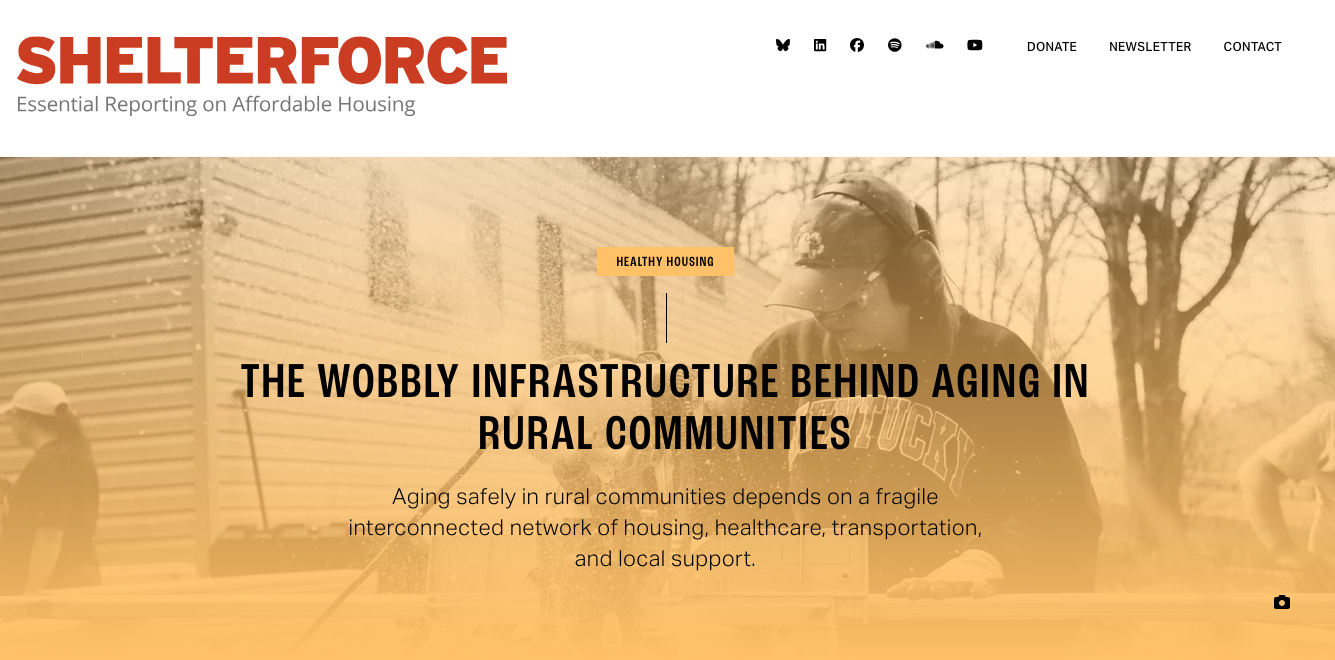
In rural communities, older adults’ housing stability is often less about skyrocketing rents or home prices and more about the condition of aging homes.
The Christian Appalachian Project (CAP) has seen this firsthand. The Kentucky-based interdenominational nonprofit serves people in need throughout the Appalachian region and provides a variety of services for older adults. One offering is its free home repair services for older people who can no longer address maintenance or repair problems themselves—either because it’s not safe to do so or simply because they can’t afford to.
But the organization’s repair list is long. The sheer number of older adults in need, combined with the escalating cost of materials, means it can sometimes take months or even years for help to arrive. Occasionally, though, a homeowner in especially urgent need gets moved to the top of the list.
That’s what happened in Karen Moore’s case. Moore is an older Kentucky homeowner whose leaky roof eventually left her home unsafe and uninhabitable. Pain from an arthritic hip and knee prevented her from performing home repairs herself, and a tight budget constrained her options.
“Her roof [had been] leaking, but she couldn’t afford to get the roof repaired,” says Tina Bryson, director of communications at CAP. Moore was added to the nonprofit’s home repair list, but CAP couldn’t address her case immediately.
As a temporary fix, Moore paid to have a tarp put on her roof, but it didn’t stop the leaks entirely. “Water dripping through the roof over time rotted out her floor in her kitchen,” Bryson says.
Eventually, Moore’s roof sprung more leaks, which led to more tarps and more holes in the floor. “So now she has all these different places [where] the floor’s rotted out. … She told me how she was afraid to go to the bathroom at night because … in the dark, [she] might go through the floor.”
After a 2021 flood, Moore called CAP to report that her home had reached the end of the road. The rotting kitchen floor finally caved in, taking the sink with it.
It was then that CAP moved Moore to the top of the list. Volunteers built her a new roof, installed new flooring and windows, and even replaced her unstable front and back porches.
Bryson, who personally helped with the repair work, says Moore told her that one of the benefits of finally getting her home repaired was that she’d be able to host her family for Christmas. “It was unsafe for them to visit [before],” Bryson says. “That gets to the isolation. When you’re living in a home that’s not safe, it impacts your relationships as well.”
For many older adults living in rural areas, their housing stability and well-being depend on a host of overlapping conditions—and if just one is compromised, the whole structure can start to crumble.
Read full story (you can also listen to a recording, 18mins)
-
Date
Aug 07, 2026
-
By
Franklin Schneider for ShelterForce
Newsletter
Sign up for the Healthy Aging CORE BC newsletter to keep up-to-date with activity from the platform and the Community-Based Seniors Services (CBSS) sector across BC and Canada.