
[Article] What Happens When a Community Is Designed to Bring Generations Together?
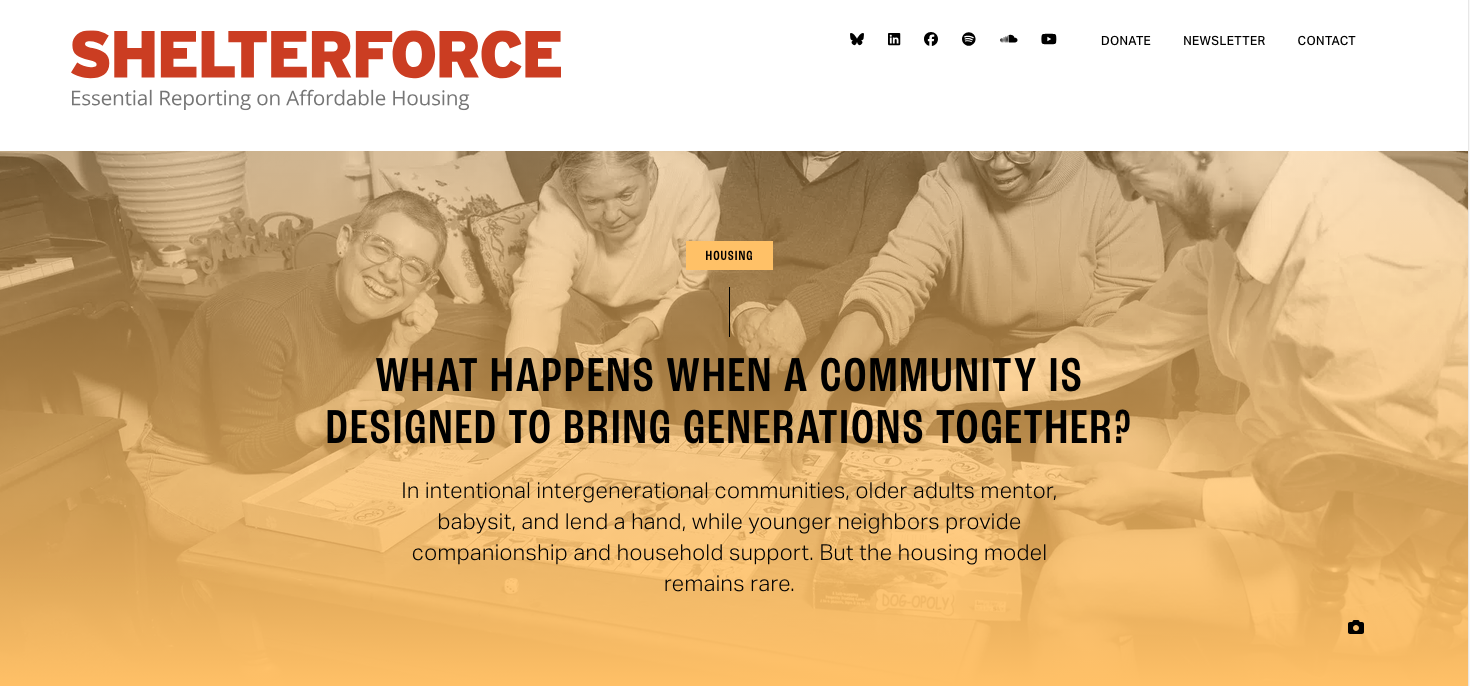
When Kahrynn Aaliyah first came across a Craigslist ad for the Nathalie Salmon House—a 53-unit affordable housing building in Chicago’s Rogers Park neighborhood—she had no idea she would form a bond that transcended language and generations.
During a tour of the building, a guide pointed out a unit rented by Olga Bashkina, a retired concert pianist from St. Petersburg, Russia. As a fellow musician, Aaliyah, 24, immediately knew she wanted to meet Bashkina.
After settling in for a few weeks, Aaliyah received a knock on her door while she was rehearsing a song. It was Bashkina, who told Aaliyah that her voice was beautiful and that she wanted to play the piano for her sometime. It sparked a neighborly bond between the two—despite Aaliyah knowing only a few words in Russian and being decades younger than Bashkina.
“Music is how we talk,” Aaliyah explains. “If we play a song, we both understand the sounds of the song, but if we try to speak [different] languages, we don’t really understand each other.”
Aaliyah and Bashkina’s sonically inclined friendship was made possible by living in an intentional intergenerational housing community, a housing model that’s still relatively rare. According to the Harvard University Graduate School of Design, there are roughly 160 of these types of housing communities in the U.S.
What Is Intergenerational Housing?
Intergenerational housing includes multigenerational arrangements in which two or more generations, often from the same family, live under one roof. This type of housing is becoming more popular after falling out of style in the 1950s, when the nuclear family took hold.
Intentional intergenerational living “includes communities designed to bring people of different generations together, whether they live in the same home, [in] separate homes within the same development, or in colocated settings that intentionally foster interaction,” according to Sheri Steinig, the director of strategic initiatives and communications at Generations United, whose mission is to determine what systems are needed to bring older and younger people together.
“One distinction we often make is that most multigenerational households arise organically within families rather than being intentionally developed, whereas intentional intergenerational housing or communities are specifically designed to encourage meaningful interaction across generations,” Steinig adds.
 Illustration courtesy of the Harvard Joint Center for Housing Studies
-
Date
Sep 09, 2026
-
By
Jill Webb for SHELTERFORCE
Newsletter
Sign up for the Healthy Aging CORE BC newsletter to keep up-to-date with activity from the platform and the Community-Based Seniors Services (CBSS) sector across BC and Canada.