
[Blog] More than a ride: What paratransit means for older adults’ independence
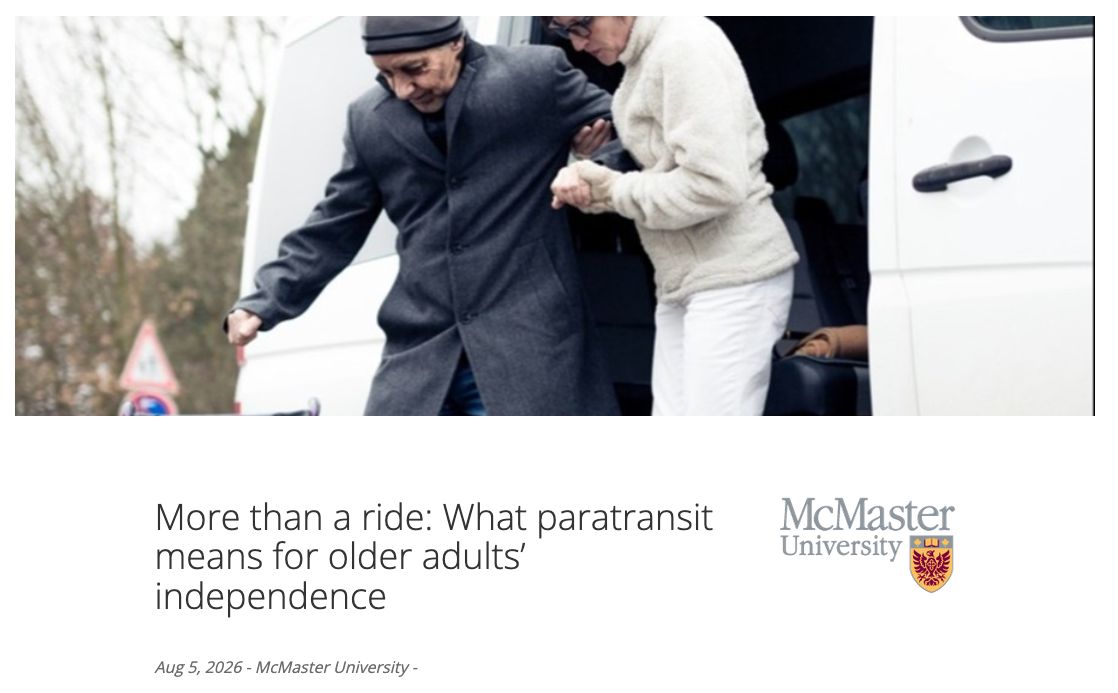
Transportation is much more than getting from point A to point B. It allows older adults to buy groceries, attend healthcare appointments, visit family, engage with their community and practice faith and maintain relationships.
For older adults who cannot drive or choose to use public transportation, losing access to a dependable ride can mean losing access to community life. It may also affect caregivers, particularly if they have to rearrange work and other responsibilities to provide transportation.
Paratransit – generally understood as accessible transportation supplementing fixed route public transit – can help fill this gap. In Canada, they might include door-to-door or curb-to-curb transportation and are sometimes booked in advance and require eligibility requirements.¹ In other countries, it can also refer to flexible or informal shared transportation that operate where public transportation is unavailable.² However, research suggests that more discussion is needed around whether paratransit allows people to live their lives as they choose, rather than just focusing on costs, routes, and operational efficiency.
What the research tells us
A critical systematic review of 57 studies about paratransit in the U.S. and Canada identified three main areas of research:
- modelling demand, routes, costs, and system information
- proposing alternative ways to deliver paratransit, such as public-private partnerships or autonomous vehicles
- examining existing paratransit services.
Of the 20 studies focusing on existing services, only four analyzed users’ perspectives. As a result, the review authors note the underrepresentation of the experiences of paratransit users in available research, which is often overshadowed by studies about reducing costs or improving operational efficiency. The authors call for more qualitative accounts of what it is like for users to depend on these services, and whether it meaningfully meets their needs.¹
Among the studies that did focus on users’ experiences, several important issues were identified. Paratransit was found to help users maintain social and community connections, but users also experienced:
- long periods of waiting for vehicles
- short windows to board a vehicle once it arrived
- inflexible scheduling and limited spontaneous trips
- service boundaries preventing travel to neighbouring communities or rural areas
- physical barriers like obstructed sidewalks that made it harder to use the service
- anxiety, frustrations, and barriers to access that limited the use of the few transportation options available to them.
The authors call for future paratransit projects and studies to put users at the centre of research and service design to better combine operational data with people’s real-world experiences.
A service is not successful merely because it is efficient
Transportation planners need to manage costs, schedules, vehicles, and demand. However, operational measures cannot explain the whole experience.
A paratransit service may appear efficient on paper while creating major difficulties for users. For example:
- Is it easy to book a trip?
- How far ahead must the trip be scheduled?
- Does the vehicle arrive within a predictable period?
- How long does the total journey take?
- Can users make spontaneous or urgent trips?
- Is assistance available when boarding and exiting?
- Can a caregiver or support person travel with the passenger?
- Is information available without requiring a smartphone?
- Are drivers respectful and appropriately trained?
- Is the service affordable enough to use regularly?
- Can users report a problem and receive a meaningful response?
These questions measure whether a transportation system supports independence rather than merely whether it moves vehicles at low cost.
What user-centered paratransit should look like and how to shape it
When paratransit works well, it can help older adults reach healthcare appointments, buy groceries, continue work or volunteering, participate in community activities, and maintain relationships. It can also relieve pressure on caregivers. To meaningfully support these goals, however, paratransit should be predictable, easy to book, and able to accommodate changing needs of users and families. For example, it should be accessible by telephone as well as through digital booking options, coordinate with other transportation services, and be evaluated on reliability, safety, affordability, and access to meaningful destinations, rather than only on cost per trip. Older adults and their caregivers should be involved early in planning and evaluation of services.
To improve paratransit services, older adults and caregivers can help make their experiences heard by:
- recording recurring delays, missed trips, long journey times, or difficulties booking or boarding vehicles
- noting which appointments, errands, or social activities were affected
- reporting both service issues and features that support independence
- asking how complaints and feedback are reviewed
- participate where possible in advisory groups, accessibility committees, or public consultations.
------------------------------------------------------------
References
- Collins T, Ravensbergen L, Young M. The landscape of contemporary paratransit research: A critical systematic review of the literature in the US and Canada. Travel Behaviour and Society. 2025;38:100930. doi:10.1016/j.tbs.2024.100930.
- Abass AS, Aljoufie M, Gbban AM. The role of paratransit in sustainable urban mobility: A scoping review. Research in Transportation Economics. 2025;113:101613. doi:10.1016/j.retrec.2025.101613.
-
Date
Aug 06, 2026
-
By
McMaster Optimal Aging Portal
Newsletter
Sign up for the Healthy Aging CORE BC newsletter to keep up-to-date with activity from the platform and the Community-Based Seniors Services (CBSS) sector across BC and Canada.