
[Commentary] Artificial intelligence regulation must not leave older adults behind
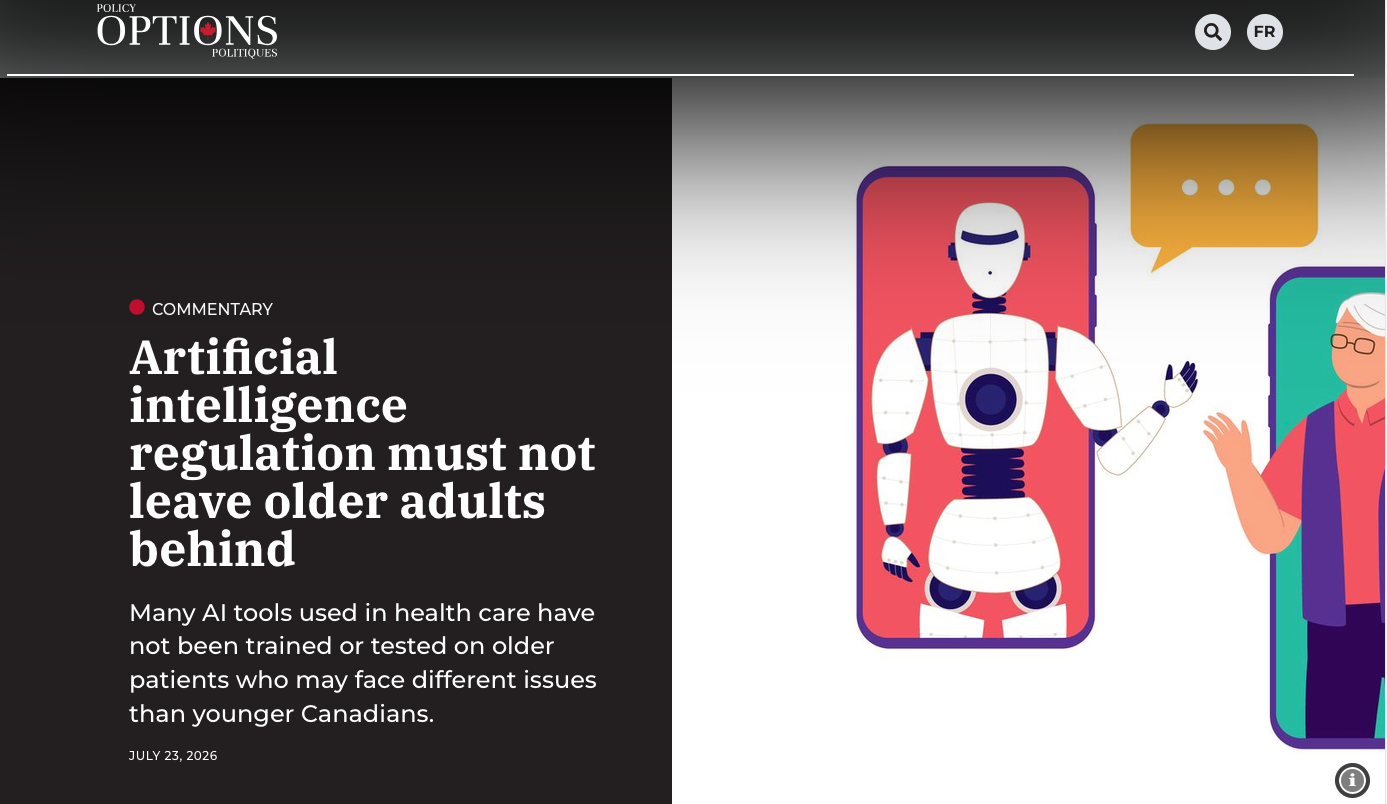
Picture your 78-year-old grandmother at a University Health Network hospital describing her symptoms to a doctor who is using an AI-enabled technology to interpret medical imaging to help make a diagnosis. However, the tool has never been tested on older patients with multiple chronic conditions such as diabetes or cardiovascular disease, or the use of various medications, or age-related physiological changes.
This scenario is not hypothetical. AI is already used by Canadian health-care providers, government services and in other environments for older adults.
Some of these tools bring real benefits, from helping interpret medical imaging and detecting cancer earlier to reducing administrative burdens and freeing clinicians to spend more time with patients.
But without proper regulation, they can also produce serious harm: diagnostic errors due to limited training data, hallucinations, discriminatory decisions and automation bias that can cause humans to make decisions based on flawed AI recommendations.
To combat this, the federal government should create a centralized AI oversight body; impose regulations based on the risks posed by AI-enabled technologies; ensure that biased age-related data is addressed before deployment; and involve older adults in the development of these policies.
The regulatory gap
The federal government has spent years investing in AI through its pan-Canadian artificial intelligence strategy yet still lacks a coherent regulatory framework capable of protecting older adults and others affected by AI-enabled technologies.
Ottawa sought to address that gap through the Artificial Intelligence and Data Act but that legislation died when Parliament was prorogued for the April 2025 election. Since then, the government has appointed a minister of artificial intelligence and digital innovation and renewed its focus under its national artificial intelligence strategy: AI for all, released in June.
But that strategy, which is weighted toward adoption and economic opportunity, is not a substitute for protection. It offers no firm commitment to a comprehensive statutory framework, deferring instead to a patchwork of future legislation and piecemeal amendments to existing statutes.
The recently tabled Bill C-34, the Safe Social Media Act, demonstrates this approach. The bill would establish safety requirements for social media services and AI chatbots used by children. These services would be required to identify and mitigate the risk of harmful content and behaviour, implement safety and age-appropriate features, and publish digital safety plans under the oversight of a new Digital Safety Commission of Canada.
While these are important and welcome safeguards for children, they are narrower than the broader framework of accountability and oversight needed for high-impact AI-enabled technologies used in health care, employment, housing and other essential services that affect older adults.
In comparison, the European Union’s Artificial Intelligence Act — one of the world’s most comprehensive AI regulatory frameworks — uses a risk-based model that classifies AI systems according to the harm they may pose, imposes stricter obligations on high-risk uses and prohibits certain unacceptable applications. Without an AI framework that considers social inequities as well as economic benefits, Canada risks falling behind.
The cost of inaction is not speculative. It leaves older adults and others exposed to AI-enabled technologies without adequate safeguards. If Canada is serious about responsible AI, its regulatory approach must explicitly account for older adults – not as an afterthought, but as a group significantly affected by AI.
How biased data puts older adults at risk
A persistent flaw in many AI-enabled technologies is that they are built on biased data. The World Health Organization has warned that AI systems routinely exclude older adults from their design and development despite the fact that older adults are primary users of health care. This means an AI-enabled technology trained on younger patients may produce less accurate diagnoses for older patients.
The problem extends beyond health care. In 2023, an American company paid a $365,000 fine after settling a lawsuit caused by its AI-based hiring software automatically rejecting male and female applicants over 60 and 55, respectively.
These are not technical glitches. They are examples of how AI can shape access to jobs, care and services, as well as reinforcing stereotypes about older adults.
According to the National Institute on Ageing’s 2025 Ageing in Canada Survey, 70 per cent of older adults reported experiencing at least one form of agism in the past year, including subtle comments, jokes and assumptions about aging. AI, without proper guardrails, risks not only reflecting that reality but reinforcing it.
Read full commentary
-
Date
Jul 30, 2026
-
By
Policy Options
Newsletter
Sign up for the Healthy Aging CORE BC newsletter to keep up-to-date with activity from the platform and the Community-Based Seniors Services (CBSS) sector across BC and Canada.