
[Research] RACHEL the Robot
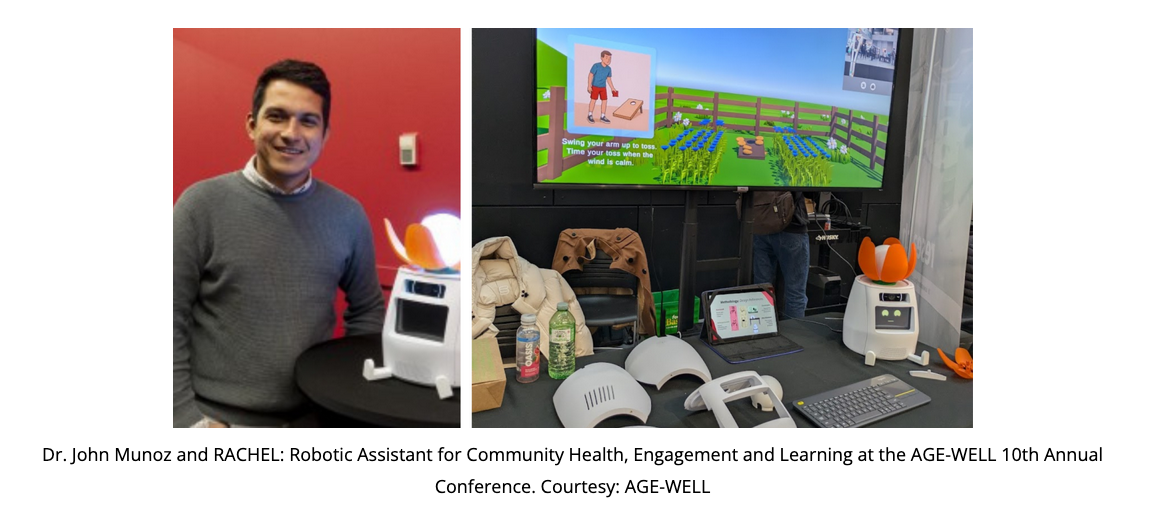
RACHEL is the name of a new interactive social robot that encourages exergaming, creativity, and community engagement among older adults, and an acronym for Robotic Assistant for Community Helped Engagement and Learning.
RACHEL is part of a project led by game designer Dr. John E. Muñoz, an Assistant Professor at Wilfrid Laurier University and researcher in human-computer interaction. RACHEL was designed as a tabletop social robot and interacts through speech and facial expressions displayed on its interface.
More than "Exer-Games"
The concept emerged from the idea of a "planter robot," inspired by the way people talk to plants as if human - believing that this interaction could positively affect the plants' well-being. RACHEL mimics this humanization by using its physical features—opening and closing to indicate task completion and achievements—as a form of communication and feedback.
RACHEL incorporates lights, movement (opening and closing), facial expressions, and speech to engage users. It can both listen and respond, creating a conversational experience. RACHEL does not employ virtual reality but connects to a display, like a TV, casting visual content related to the activities.
Central to its purpose is promoting physical activity through a menu of "ExerGames" that react to a user's movements. Users can ask RACHEL for exercise suggestions, and RACHEL will offer games focusing on balance or coordination, such as cornhole and frisbee. Movement tracking is achieved through a front-facing camera, allowing the robot to provide feedback and coaching during gameplay. RACHEL encourages users, corrects their movements when necessary, and motivates them to continue when they succeed.
A key challenge in developing social robots like RACHEL is articulating the unique value of embodied robotics—what a robot offers beyond what screens and sensors can provide. “One of the challenges that always comes up when building social robots is answering the question - why do you need a robot for that?” says Muñoz. “I’m working on the embodiment aspect to consider - what is a robot bringing to the scenario that is unique?”. Embodiment is believed to enhance coaching and encouragement, offering a presence that virtual agents cannot.
Co-designing the future together with older adults
RACHEL is being co-designed with older adults. “I invited two groups of older adults to come to my lab and asked them - what kind of robot would be interesting to have at home and to encourage you to do physical activity?”. This collaboration revealed important insights; for instance, participants preferred robots that were not overly bulky, favouring soft or plastic, tabletop designs over large, metallic or humanoid forms. Both groups expressed a strong preference for voice-based interaction, likening it to familiar technologies such as Siri, Alexa, or WhatsApp voice messaging. The results of this research were presented at the International Conference on Social Robotics (https://icsr2025.eu/) in Italy during the past summer.
Direct involvement of end-users helped shape not only RACHEL’s physical appearance but also its interactive features, ensuring the robot’s embodiment and functionality were closely aligned with user expectations and day-to-day realities. This co-design approach was fundamental in distinguishing RACHEL as a social robot with unique value, rooted in the lived experiences and desires of its intended users.
Next Steps
RACHEL is in an early prototype stage, with ongoing research and development to explore its capabilities, and to assess engagement and usability. The first prototype is being introduced in long-term care homes and spaces where older adults participate in daily programs.
Potential future applications include simplifying tasks such as video calls, leveraging RACHEL's camera and display connectivity for easier communication in living spaces. RACHEL could serve as a conduit for launching games, puzzles, storytelling, and other interactive activities, or even moderating interactive videocalls with family and friends addressing gaps in engagement and leisure opportunities, particularly in long-term care settings.
GET MORE INFORMATION
The BioAdaptive Interface Lab at Wilfrid Laurier University conducts research that spans areas such as serious games, virtual reality simulations, social robotics, and brain-computer interfaces employing human-computer interaction methodologies.
Learn more at www.bioadaptiveinterface.com.
Dr. Muñoz is an AGE-WELL-affiliated Early Career Researcher who holds a Fellowship with Early Professionals, Inspired Careers in AgeTech (EPIC-AT), powered by AGE-WELL, hosted at the University of Toronto, and funded through the Canadian Institutes of Health Research and other partners across Canada. AGE-WELL is Canada’s Technology and Aging Network. For over a decade, AGE-WELL has served as a catalyst for technological innovation that advances Canada’s AgeTech sector and empowers older adults to live healthy, independent and engaged lives.
Learn more at www.agewell-nce.ca.
-
Date
Jan 19, 2026
-
By
Dementia Connections
Newsletter
Sign up for the Healthy Aging CORE BC newsletter to keep up-to-date with activity from the platform and the Community-Based Seniors Services (CBSS) sector across BC and Canada.