
[Data Tool] Health Inequalities in older adults (65+) in Canada
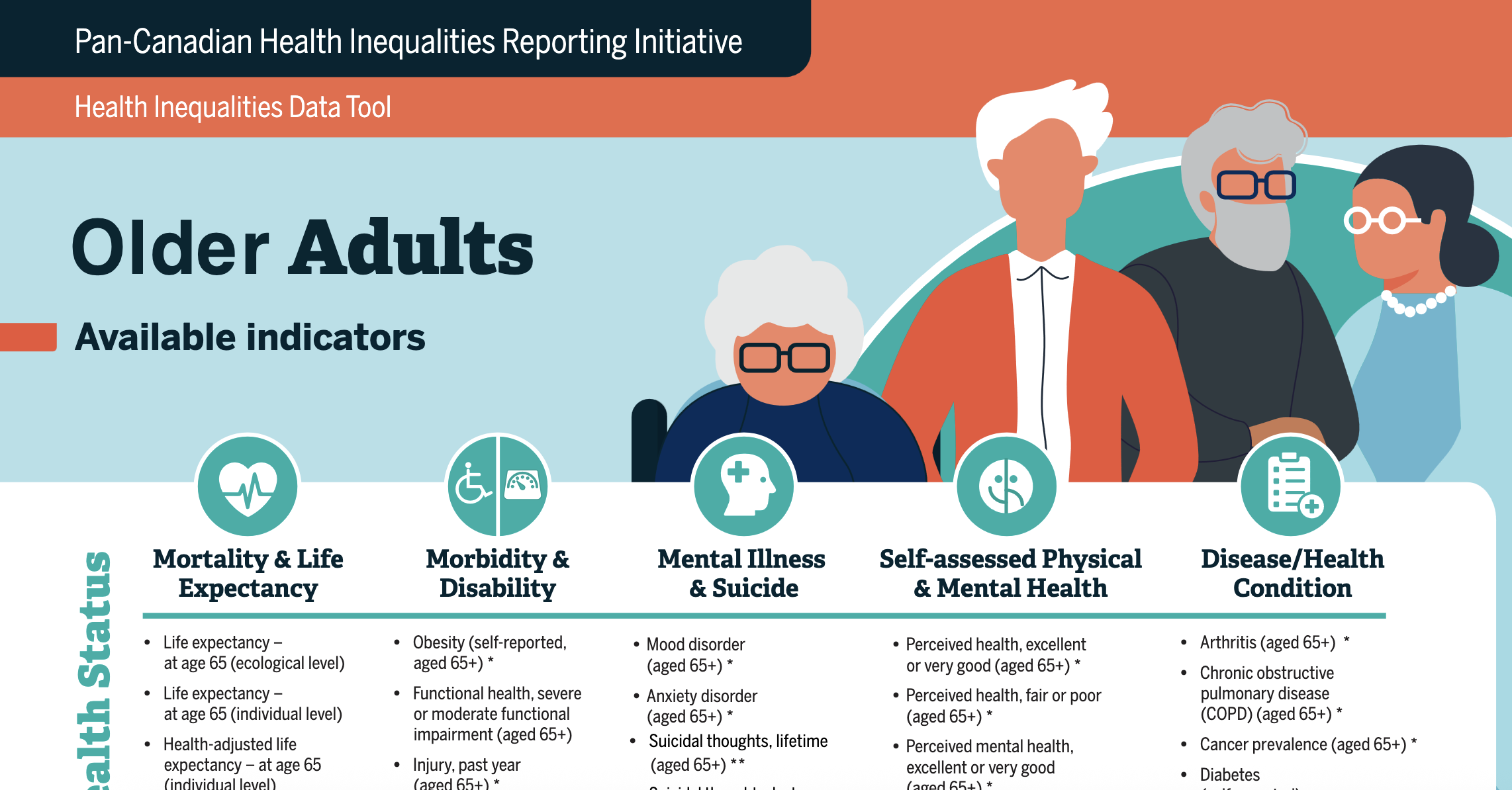
Health inequalities refer to differences in health status between groups in society. These differences can be due to biological factors,individual choices, or chance, but public health evidence suggests that many are attributable to the unequal distribution of the social and economic factors that influence health (e.g. income, education, employment, social supports) and exposure to societal conditions and environments largely beyond the control of the individuals concerned.
The Health Inequalities Data Tool supports Canada’s pledges under the Rio Declaration. This resource is a collaborative effort of the Public Health Agency of Canada, the Pan-Canadian Public Health Network (PHN), Statistics Canada, and the Canadian Institute for Health Information, and builds on a set of indicators of health inequalities proposed by the PHN in 2010.
The Health Inequalities Data Tool contains data on indicators of health status and health determinants, stratified by a range of social and economic characteristics (i.e. social stratifiers) meaningful to health equity. Indicators are grouped into twelve framework components.
Explore Health Inequalities Data Tool website (https://health-infobase.canada.ca/health-inequalities/)
Read about Health Inequalities in older adults in Canada
- Self-assessed physical and mental health
- Health behaviors: self-reported physical activity
- Social determinants of health: low income
- Social determinants of health: living alone
- Social determinants of health: food insecurity
- Improving health among older adults
-
By
Government of Canada
-
Published
Jun 09, 2026
-
Subject Area
- Resources & Reports - National
- Income & Poverty Reduction
- Healthcare
-
Category
Newsletter
Sign up for the Healthy Aging CORE BC newsletter to keep up-to-date with activity from the platform and the Community-Based Seniors Services (CBSS) sector across BC and Canada.